



 AJPN Home



Abstract
Introduction: Congenital heart diseases encompass a wide spectrum of heart defects with a significant morbidity burden across lifespan. Previous studies have shown patient and parental health literacy on congenital heart diseases is often insufficient. This study aimed to validate the Spanish version of the Leuven Knowledge Questionnaire and perform a cross-sectional study of congenital heart diseases related knowledge among families of children with congenital heart diseases in our institution.
Methods: The Leuven Knowledge Questionnaire cross-cultural adaptation and validation was based on the international Consensus-based Standards for the Selection of Health Measurement Instruments guidelines (COSMIN). The cross-sectional study was based on the Spanish version of Leuven Knowledge Questionnaire.
Results: The Spanish version of the Leuven Knowledge Questionnaire validation included 20 adults with congenital heart disease showing adequate content validity for relevance and clarity after minor adaptations into the Spanish context. The cross-sectional study included 148 dyads (children with congenital heart diseases and their parents). Overall, 59.9% patients were male, mean age 11.9 years (± 5.54), 74.8% had undergone cardiovascular surgery. Parental respondents were predominantly mothers (74.2%), mean age 44 years (± 8.75), 56.5% with a university degree. Remarkably, 18.6% of parents misidentified their child’s congenital heart diseases diagnosis, 83% couldn’t identify all listed heart failure symptoms, 66.6% lacked knowledge about medication side effects and 60.6% were unfamiliar with endocarditis. Lower income and education levels were associated with reduced congenital heart diseases related knowledge (p=0.01).
Conclusions: Parental congenital heart diseases knowledge in our sample was insufficient, particularly in areas critical to disease management. Comprehensive follow-up programs incorporating structured health education are essential to reduce congenital heart diseases related morbidity. The Spanish version of the Leuven Knowledge Questionnaire is a valid tool for assessing congenital heart diseases related knowledge and might be integrated into pediatric follow-up programs.
Keywords:Leuven Questionnaire; Congenital Heart Disease; Health Literacy
Highlights:Previous studies have showed disease-related knowledge among congenital heart diseases patients is limited .This is the first study validating the Leuven Knowledge Questionnaire into Spanish and further evaluating health literacy among Spanish families caring for a child with congenital heart diseases. In our study while the majority of parents (75.2%) could identify their children’s cardiac condition, either partially or completely, 66.6% lacked knowledge about medication side effects and interactions, 60.6% were unfamiliar with endocarditis and 88.2% could not identify its typical symptoms. In line with previous literature, lower income and education levels were significantly associated with reduced congenital heart diseases -related knowledge (p = 0.01).
Introduction
Congenital heart diseases, present in about 1.0% of all live births, are the most common birth defects encompassing a heterogeneous group of cardiovascular conditions with distinct phenotypes, prevalence, risk factors, and outcomes [1]. Advances in surgical techniques and perioperative management have significantly reduced the perioperative congenital heart disease mortality, thus redefining congenital heart diseases mostly as a chronic condition [2]. The current ever-ascending prevalence of children and adults with congenital heart diseases demands a public health approach to address the complex challenges that may potentially arise across patient’s life span [3]. Congenital or acquired diseases benefit from standardized education strategies aimed for patients and their families to ensure appropriate management. Health literacy is especially relevant for congenital heart diseases patients prone to complications such as arrhythmias, bacterial endocarditis, congestive heart failure or pulmonary vascular disease [2]. A prompt and adequate identification of cardiac decompensation facilitates rapid intervention, potentially reducing morbidity and mortality. However, previous studies have showed disease-related knowledge among congenital heart diseases patients is limited [4-9].
The Leuven Knowledge Questionnaire was developed to assess
the knowledge of adult patients with congenital heart diseases [4].
It consists of 27 questions grouped into four domains:
a) Disease and treatment
b) Prevention of complications
c) Physical activity
d) Sexuality and heredity
The questionnaire includes several response formats, such as dichotomous items, congenital heart diseases graphic anatomical recognition, and multiple-choice questions regarding general aspects of congenital heart diseases management. The answers are categorized as 1 (correct), 2 (wrong), 3 (unknown), or 4 (incomplete). The Leuven Knowledge Questionnaire has been translated into different languages and is widely used internationally [6-8,10-12].
A pediatric adaptation of the Leuven Knowledge Questionnaire has been previously published to study parental knowledge of congenital heart diseases [5]. However, to date, a Spanish version has not been developed, and no other studies have objectively investigated health literacy among patients with congenital heart diseases across Spanish-speaking population. This study aimed to validate the Leuven Knowledge Questionnaire into Spanish and to adapt it for parental use. Further, a cross-sectional analysis of congenital heart diseases -related knowledge in families of children with congenital heart diseases at our institution based on the validated Spanish version of the Leuven Knowledge Questionnaire for parental use was performed.
Materials and Methods
The study was divided into 2 phases: 1) Leuven Knowledge Questionnaire validation and 2) Cross-sectional study.
Phase 1: Translation, Cross-Cultural Adaptation, and Validation of the Spanish version of the Leuven Knowledge Questionnaire into Spanish
The first phase of the study involved the translation, crosscultural adaptation, and validation of the Leuven Knowledge Questionnaire into Spanish, following the Consensus-based Standards for the Selection of Health Measurement Instruments (COSMIN) guidelines.
This process comprised six stages:
I. Initial translation
II. Synthesis of translations
III. Back-translation
IV. Expert committee review
V. Pre-testing
VI. Content validation [13].
A preliminary, unified back-translated Spanish version of the Leuven Knowledge Questionnaire was developed following several consensus meetings among the research team to ensure semantic (word equivalence), idiomatic (expression equivalence), and experiential equivalence (cultural appropriateness of words and situations). Approval was obtained from the original author of the questionnaire [4].
Content Validity Assessment: Content validity was assessed by a panel of five healthcare providers with expertise in congenital heart diseases care: a pediatric cardiologist, an adult cardiologist, a pediatric cardiac intensivist, a neonatal cardiac intensivist and an Advance Practice Nurse (APN). The Content Validity Index, a quantitative method for evaluating item relevance and clarity, was used [14]. Each item was rated on a 4-point scale (1 = not relevant to 4 = very relevant) to assess both relevance of the Content Validity Index for relevance and clarity in relation to congenital heart diseases knowledge. Researcher’s evaluations were obtained through open-ended responses evaluating the 27 items of the Spanish version of the Leuven Knowledge Questionnaire. Scores were dichotomized as 1 (“relevant/clear”) or 0 (“not relevant/ not clear”). Both Content validity index for relevance and clarity were calculated for each item and averaged across raters, with cut-off values >0.78 for individual items and >0.9 for the overall scale [15].To ensure clarity and accuracy, the Spanish version of the Leuven Knowledge Questionnaire version was piloted in a convenience sample of 20 adults (≥18 years) with congenital heart diseases during scheduled out-patient clinic follow-up, that were invited to participate during routine outpatient visits. The thinkaloud protocol was used, allowing responders to verbalize their interpretation of each item while completing the questionnaire.
Parental Adaptation: A final adaptation for parental use was undertaken by minimally modifying the questionnaire into the third-person form. The final version of the Spanish version of the Leuven Knowledge Questionnaire is presented in Supplementary Material 1.
Phase 2: Cross-Sectional Study
A cross-sectional study was carried out among families caring for children with congenital heart diseases using the selfreported Spanish version of the Leuven Knowledge Questionnaire for parental use. Parents and caregivers of 148 children with congenital heart diseases, aged 0-18 years, were consecutively recruited during routine outpatient evaluation at our institution. Inclusion criteria were families caring for a child with congenital heart diseases under clinical follow-up at our institution, with at least one parent being fluent in Spanish. Patients without parental main care or unwilling to participate were excluded.
The study was explained to participants both verbally and in writing. Thereafter, the questionnaire was distributed to parental participants who consented to participate and were asked to complete the questionnaire independently and without consulting external reference material. Relevant clinical information was collected from the patients’ medical records, including primary diagnosis, procedures received, medication use, history of endocarditis, comorbidities and functional class. This study was conducted between December 2024 and April 2025 following approval by the Ethics and Research Committee (CEIm num: PIC- 102-24).
Results
Phase 1: Translation, Cross-Cultural Adaptation, and Validation of the Leuven Knowledge Questionnaire into Spanish
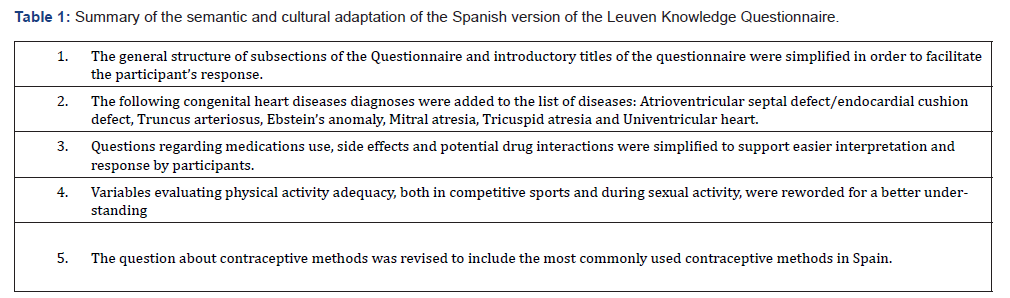
Several changes were required to ensure semantic and cultural equivalence of the Spanish version of the Leuven Knowledge Questionnaire with the original questionnaire (Table 1). Those changes included the simplification of the structure as well as the instructions; adding additional congenital heart diseases diagnosis; rewording medication and physical activity questions for clarity, and revising contraceptive options to reflect common practices in Spain. After the panel consensus meeting, the Spanish version of the Leuven Knowledge Questionnaire demonstrated adequate content validity. The item content Validity Index for relevance was > 0.79 with a scale average of 0.90. The item content Validity Index for clarity > 0.75 with a scale average of 0.93. Individual values for each item are provided in Supplementary Material 2.
Phase 2: Cross-Sectional Study
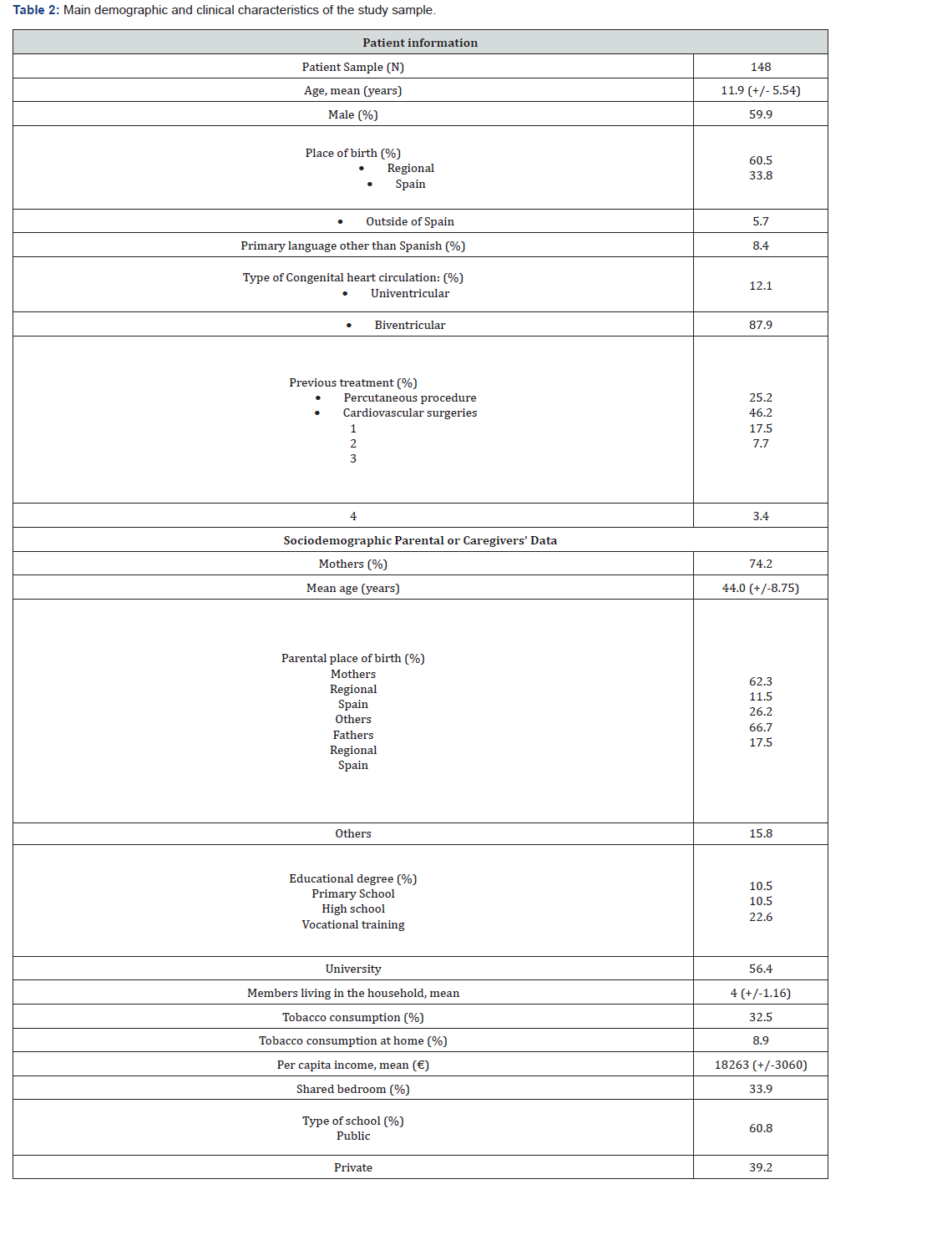
Sample Characteristics: The study included a sample of 148 families caring for children with congenital heart diseases. Among the children, 59.9% were male, with a median age of 11.9 years (± 5.54). Most (74.8%) had undergone corrective or palliative cardiovascular surgery, and 14.5% had only percutaneous procedures. Most responders were predominantly mothers (74.2%), with a median age of 44 years (± 8.75), 71.2% were born in Spain and 56.5% held university degrees (Table 2). summarizes the main demographic and clinical variables of our population.
Congenital heart diseases Knowledge Outcomes
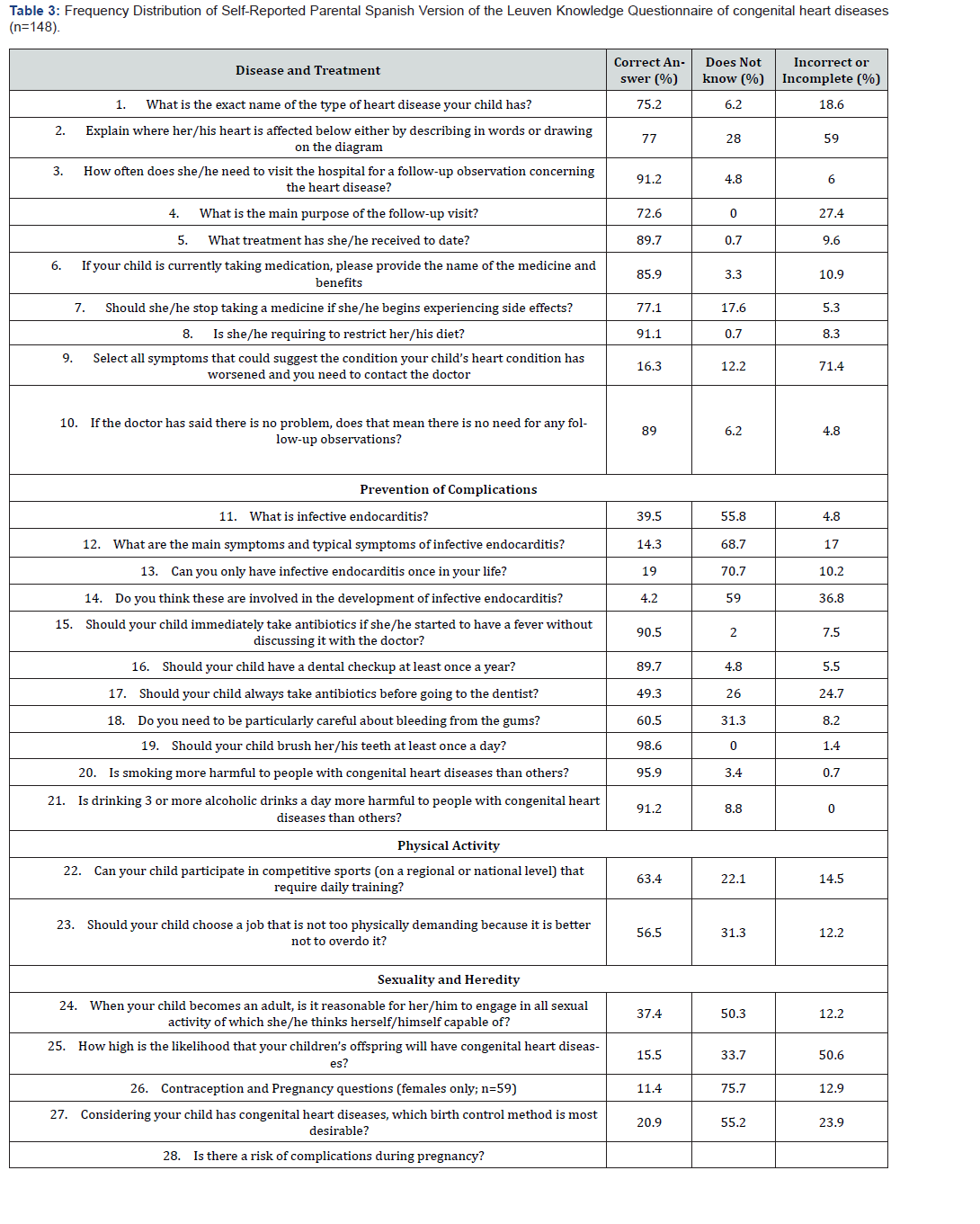
Disease and Treatment: Overall, 18.6% of parents
misidentified their child’s specific congenital heart diseases
diagnosis, and 6.2% reported being completely unaware of their
child’s condition; 66.6% lacked knowledge about medication side
effects and drug interactions. Only 16.3% correctly identified all
listed symptoms of heart failure.
Prevention of Complications: More than half (60.6%) of the
parents were unfamiliar with endocarditis, and 88.2% could not
recognize its typical symptoms. While 89.7% knew that annual
dental care was necessary, 39.9% were unaware that bleeding
gums require additional care. More than 90% identified smoking
and alcohol consumption as harmful for congenital heart diseases
patients. Further, 31.3% of the respondents were unsure whether
a low-intensity physically demanding job would be suitable.
Sexuality and Heredity: Almost 85% were unaware of
the hereditary nature of congenital heart diseases in offspring.
Knowledge scores were significantly lower among families
with lower income or lower educational attainment (p = 0.01).
Detailed items-level responses are presented in (Table 3).
Parental responses for each domain of the Spanish version of the
Leuven Knowledge Questionnaire for parental use are presented
showing frequencies of correct, incorrect, unknown or incomplete
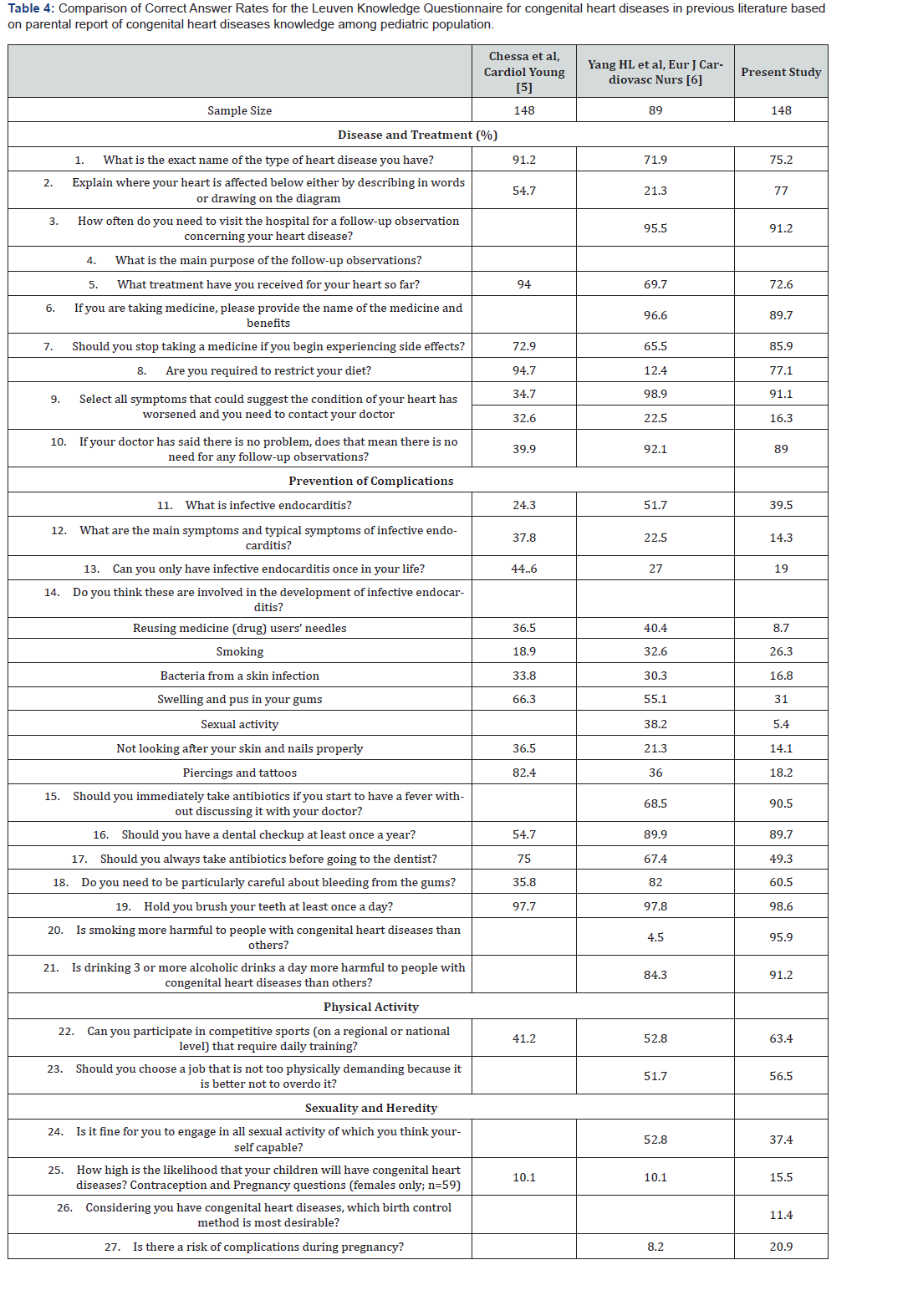
answers. A comparative review of these responses with previous
international studies conducted internationally [5,6] is presented
in (Table 4).
Discussion
To the best of our knowledge, this is the first study validating the Leuven Knowledge Questionnaire into Spanish and further evaluating health literacy among Spanish families caring for a child with congenital heart diseases. The Leuven Knowledge Questionnaire was developed in 2001 by Philip Moons [4] covering four domains that evaluated congenital heart diseases health literacy (disease, prevention, physical activity and reproductive variables) and was initially applied to adult patients with congenital heart diseases. In 2009, a new version of the questionnaire divided the fourth domain into two: sexuality and heredity and contraception and pregnancy planning only aimed at female patients. According to the author, although this questionnaire was initially designed for patient’s knowledge assessment, it can be adapted for parental administration [4,13,16]. The resulting Spanish version) showed semantic, cultural and conceptual equivalence with the original after only minor modifications. The inter-rater assessment regarding clarity and relevance showed adequate results, with all scores above 0.6. These findings are consistent with those reported previously validated versions of the Leuven Knowledge Questionnaire in Chinese, Portuguese and Japanese [6,8,10].
Appropriate knowledge of congenital heart diseases has shown to promote commitment to care [17]. Health literacy improves self-care and helps control risk factors in order to improve quality of life [18]. In congenital heart diseases, especially in pediatric patients, it is essential for parents to adopt adequate life style habits and resources to cultivate a discerning approach when facing possible decompensations. However, previous studies have shown that both patients with congenital heart diseases and their parents often lack sufficient health-related knowledge [19-25]. In our study, we assessed parents’ understanding of their child’s congenital heart diseases using the Spanish version of the Leuven Knowledge Questionnaire for parental use and found concerning knowledge gaps. While the majority of parents (75.2%) could identify their children’s cardiac condition, either partially or completely, and were aware of previous interventions (89.7%), 66.6% lacked knowledge on medication side effects and interactions, 60.6% were unfamiliar with endocarditis and the vast majority (88.2%) could not identify its typical symptoms. In our sample, lower income and education levels were significantly associated with reduced congenital heart diseases -related knowledge (p = 0.01) in line with previous literature [5,10].
In our cohort, only 16.3% of parents were able to correctly identify the symptoms of heart failure, a proportion lower than those reported by previous studies [5,6]. Regarding prevention factors, our sample showed similar knowledge when compared to previous studies, with risk factors for infective endocarditis being very poorly understood among congenital heart diseases patients and families. Interestingly, more than 90% of respondents recognized the harmful effects of smoking and alcohol. Another relevant aspect is the role of physical activity; it has been previously reported that parents often lack adequate knowledge about safe levels of physical activity in children with congenital heart diseases [25]. Promoting its beneficial effects, even on patients with congenital heart diseases, should be a fundamental part of health education. An adapted further version of the Leuven Knowledge Questionnaire could include questions regarding functional status and the impact of exercise on health. In line with previous studies [5,6,10], the adaptation of the Spanish version of the Leuven Knowledge Questionnaire for parental use, revealed that certain variables-such as those concerning contraceptive use, smoking, alcohol consumption and physical activity during work or sexual intercourse-are contextually difficult to apply to parents of children under 12 years of age. Many parents were unfamiliar with the answers, likely due to them had not yet been addressed during pediatric cardiology consultations.
Therefore, the Spanish version of the Leuven Knowledge Questionnaire for parental use may not accurately reflect parental knowledge regarding young children with congenital heart diseases and a further adapted version for parents could gather more representative and accurate data. This study has some limitations that should be taken into account: it is a single-center study, the sample size is limited and families with university degrees represent over 50% of our sample. Data is based on parental responses without an in-depth study of the adolescents’ own knowledge. Further, including families with very young children such as infants and toddlers might not accurately reflect parental knowledge regarding areas such as endocarditis risk factors, contraceptive methods among others. However, our results align with previous similar reports incorporating the use of the Spanish version of the Leuven Knowledge Questionnaire validated into Spanish.
In conclusion, previous evidence has related patient and parental congenital heart diseases knowledge to improved quality of life, lower anxiety, better coping strategies and greater adherence to treatment. Therefore, educational initiatives should be incorporated into routine follow-up care and tailored to the child’s developmental stage, ideally involving a multidisciplinary team including cardiologists, specialized nurses and other relevant healthcare professionals. The validated Spanish version of the Leuven Knowledge Questionnaire provides valuable instruments for assessing and strengthening both patient and parental knowledge of congenital heart diseases, thereby offering a more informed and holistic long-term care.
References
- Bernier PL (2010) The challenge of congenital heart disease worldwide: epidemiologic and demographic facts. Semin Thorac Cardiovasc Surg Pediatr Card Surg Annu 13(1): 26-34.
- Jenkins KJ (2019) Public Health Approach to Improve Outcomes for Congenital Heart Disease Across the Life Span. J Am Heart Assoc 8(8): e009450.
- Jenkins KJ (2018 ) Public health approach to reduce mortality for congenital heart defects: dying too soon. J Am Coll Cardiol 71(21): 2447-2449.
- Moons P (2001) What do adult patients with congenital heart disease know about their disease, treatment, and prevention of complications? A call for structured patient education. Heart 86(1): 74-80.
- Chessa M (2005) What do parents know about the malformations afflicting the hearts of their children? Cardiol Young 15(2): 125-129.
- Yang HL (2012) Measuring knowledge of patients with congenital heart disease and their parents: validity of the Leuven Knowledge Ques-tionnaire for congenital heart disease. Eur J Cardiovasc Nurs 11(1): 77-84.
- Ahn JA (2014) Comparison of coping strategy and disease knowledge in parents and their adolescents with congenital heart disease. J Cardiovasc Nurs 29(6): 508-516.
- Akiyama N (2021) Objective and Personalized Assessment of Disease-Related Knowledge Among Patients with Congenital Heart Disease - Development and Validation of the Japanese Version of the Leuven Knowledge Questionnaire for Congenital Heart Disease. Circ Rep 3(10): 604-614.
- Brida M (2025) Adult Congenital Heart Disease patients understanding of their condition in Central and South-Eastern Europe: Current status and opportunity for addressing shortfalls and for better care. Eur J Prev Cardiol 16: zwaf207.
- Cecchetto FH (2021) Translation, cross-cultural adaptation, and validation of the Leuven Knowledge Questionnaire for congenital heart disease instrument into Brazilian Portuguese. J Pediatr Rio J 97(4): 402-408.
- Werner O (2021) Impact of a transition education program on health-related quality of life in pediatric patients with congenital heart disease: study design for a randomized controlled trial. Health Qual Life Outcomes 19(1): 23.
- Barbas de Albuquerque F (2025) Knowledge and perception among adults of their congenital heart disease: A single center cross-sectional study. Rev Port Cardiol 44(2): 95-103.
- Gagnier J (2025) COSMIN reporting guideline for studies on measurement properties of patient-reported outcome measures: version 2.0. Quality of Life Research 34(7): 1901-1911.
- Lynn MR (1986) Determination and quantification of content validity. Nurs Res 35(6): 382-385.
- Polit DF ( 2007) Is the CVI an acceptable indicator of content validity? Appraisal and recommendations. Res Nurs Health 30(4): 459-467.
- Franco AR (2021) Steering clear from ‘lost in translation’: cross-cultural translation, adaptation, and validation of critical thinking mindset self-rating form to university students. Stud High Educ.
- Etnel Jr (2017) Development of an online, evidence-based patient information portal for congenital heart disease: a pilot study. Front Cardiovasc Med 4: 25.
- Hilton-Kamm D (2014) How not to tell parents about their child's new diagnosis of congenital heart disease: an internet survey of 841 parents. Pediatr Cardiol 35(2): 239-252.
- Mahdi LM (2009) Parental knowledge of their children’s congenital heart disease and its impact on their growth. Khartoum Med J.
- Yang HL P (2013) An evaluation of disease knowledge in dyads of parents and their adolescent children with congenital heart disease. J Cardiovasc Nurs 28(6): 541-549.
- Vituri D, Fidedignidade de indicators de quali-dade do Cuidado de enfermagem: testando a concordância e confabulated interavaliadores. Rev Latino-Am Enfermagem.
- Elsobky FA (2018) The effect of pre-hospital discharge care program on mothers’ knowledge and reported practice for children with congenital heart surgery. J Nurs Educ Pract.
- Hancock HS (2018) A randomised trial of early palliative care for maternal stress in infants prenatally diagnosed with single-ventricle heart disease. Cardiol Young 28(4): 561-570.
- Helm PC (2018) congenital heart disease patients’ and parents’ perception of disease-specific knowledge: health and impairments in everyday life. Congenic Heart Dis 13(3): 377-383.
- Swan L (2000) Exercise prescription in adults with congenital heart disease: a long way to go. Heart 83(6): 685-687.

























