




 AJPN Home



Abstract
Background: Since the 1970s, the medical and nonmedical use of opioids has increased exponentially in women of childbearing age. Studies comparing maintenance therapies (buprenorphine and methadone) have conflicting results. These reviews also show that neonatal outcome is most often measured by duration of treatment, treatment completion rates or length of hospitalization. Patient-important clinical outcomes are more rarely evaluated and are rarely chosen as primary outcomes. However, scores used to adapt NAS therapy (such as Lipstiz or Finnegan) are based on these symptoms.
Objective(s): The aim of our study was to investigate neonatal outcome, using clinical criteria, after in utero exposure to buprenorphine or methadone.
Study Design: We conducted a retrospective study analysing data from infants admitted for NAS in two NCIU between January 2010 and December 2020. The inclusion criteria were: infants born after 37 weeks gestation, born to mothers who were treated with maintenance (buprenorphine or methadone) therapy during pregnancy and who had a Lipsitz score of 4 or higher. Statistical analysis was performed using SPSS version 25 (IBM Corporation, Armonk, NY). The groups were compared using analysis of variance for normally distributed and Kruskal– Wallis for non-normally distributed continuous variables.
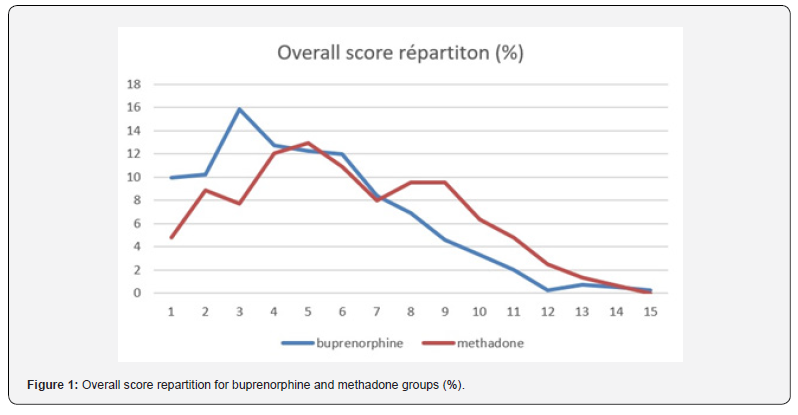
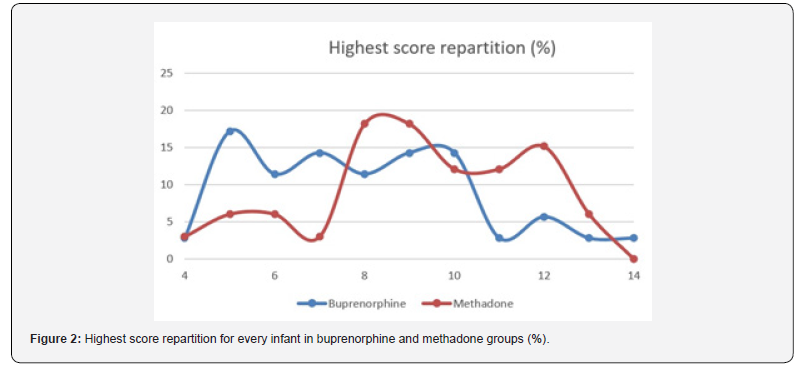
Results: A total of 150 term new-borns were hospitalized for the treatment of NAS from mother substituted with buprenorphine or methadone during the study inclusion period. The repartition of NAS scores differed significantly between buprenorphine and methadone groups, with higher Lipsitz scores in the methadone group with p-value <0.003. On average, infants exposed to methadone suffered 6 more days from NAS versus buprenorphine (p < 0,05). They also stay 3 additional days hospitalized on average (p < 0,05). Infants exposed to methadone versus buprenorphine required 80% higher initial dose of morphine and 34% higher maximal dose (p <0.05). Less infants received Morphine therapy in buprenorphine group (55%) than in the methadone group (63%) (p < 0,05). No significant difference was found regarding the delay of appearance of NAS. Concerning the highest Lipsitz score obtained for each infant, scores differed significantly between both groups in favor of buprenorphine group (p < 0,03). On average, infants from the methadone group versus buprenorphine group had a higher appearance rate for three types of symptoms: tremor (p = 0,018), reflexes (p < 0,01) and muscle tone (p = 0,01).
Conclusion(s): Our study assessed the clinical differences in neonatal outcome between buprenorphine or methadone maternal maintenance therapy and found a statistically significant difference for our primary outcome in favour of buprenorphine. The number of occurrences of low Lipsitz score was higher in the buprenorphine group and the number of occurrences of high lipsitz score was higher in the methadone group. Our secondary outcome reinforces this as the methadone group had higher maximal scores and more frequent neurological symptoms such as tremor, muscle tones and reflexes.
Keywords:Neonatal Abstinence Syndrom, Buprenorphine, Methadone, Maintenance therapy, opioid, Lipsitz score
Introduction
Neonatal abstinence syndrome (NAS) is a drug withdrawal syndrome occurring mainly after in-utero opioid exposure [1,2]. Signs of NAS range from neurologic manifestations (tremors, increased muscle tone, hyperactive reflexes, seizures), to gastrointestinal manifestations (diarrhea, vomiting, uncoordinated sucking, and swallowing) and autonomic manifestations (fever, sweating, nasal stuffiness, and increased respiratory rate) [2-4]. Since the 1970s, the medical and nonmedical use of opioids has increased exponentially in women of childbearing age [5].
This has led to a growing incidence of NAS [6]. methadone has commonly been used as maintenance therapy since the 1970s [7,8] with maternal and neonatal complications [9]. Thought to be a safe alternative to morphine, many studies describe similar symptoms to NAS [1,7,10]. Nowadays, methadone is still the reference treatment for maintenance therapy in many countries like the USA [11]. In the 1990s, buprenorphine was approved as an alternative to methadone [12,13]. This partial mu-opioid receptor agonist binds to opioid receptors with higher affinity but lower activity than full agonists like methadone and Heroin [14,15]. Quickly, buprenorphine has also been proven to cause NAS-like symptoms [16].
Still, gaps persist in regards to pharmacodynamics, pharmacokinetics, and the lack of guidelines for adequate dosage during pregnancy of methadone [17] and buprenorphine [18,19]. However, methadone may interrupt neural growth and function in early brain development [20]. This theory is supported by prior studies showing exaggerated neurological manifestations in methadone-related NAS [4,21,22]. Moreover, as a long-acting opioid, methadone can delay NAS appearance causing diagnostic problems and longer symptoms [4]. Recently, studies have shown a dose effect with higher risk of NAS with higher doses of methadone maintenance therapy [23]. The properties of buprenorphine make it less likely to cross the placenta barrier and lower its impact [24]. Moreover, literature tends to show that low-dose buprenorphine gives less NAS, especially if daily doses are split as suggested by Caritis et al. [25]. These findings are confirmed by models on rodents [26,27].
Studies comparing both maintenance therapies have conflicting results. While some studies show that neonates exposed to maternal buprenorphine consumption have NAS symptoms of less severity [28-33] requiring less treatment [17,34,35] and with better physiological parameters [35-37] than those with maternal methadone consumption. Others concluded that the evidence was insufficient to prefer one over the other [38-42] or even that methadone could be better [43]. This is highlighted by two recent reviews concluding that current data was insufficient to determine the superiority of methadone over buprenorphine or other agents when considering patient important outcomes even if they admitted a trend in favor of buprenorphine maintenance therapy [44,45]. These reviews also show that neonatal outcome is most often measured by duration of treatment, treatment completion rates or length of hospitalization. Patient-important clinical outcomes are more rarely evaluated and are rarely chosen as primary outcomes. However, scores used to adapt NAS therapy (such as Lipstiz or Finnegan) are based on these symptoms. We did not find studies based on the analysis of these scores and the symptoms observed during NAS. To our knowledge, the results of clinical scores have never been studied to weigh buprenorphine against methadone. The aim of our study was to investigate neonatal outcome, using clinical criteria, after in utero exposure to buprenorphine or methadone.
Materials and Methods
Study Population
We conducted a retrospective study analyzing data from infants admitted for NAS in two NCIU between January 2010 and December 2020. The inclusion criteria were: infants born after 37 weeks gestation, born to mothers who were treated with maintenance (buprenorphine or methadone) therapy during pregnancy and who had a Lipsitz score of 4 or higher [3]. Signs and symptoms of NAS were objectively assessed by nurses and doctors using a Lipsitz neonatal abstinence scale. According to treatment protocoles in both NCIU, morphine was used to treat NAS if the scores were higher than 4 for two consecutive days. Any clinical history and maternal history was extracted from the neonate medical chart of the databases of both hospitals. Infants were divided into two groups according to maternal maintenance therapy. All infants were monitored for NAS including those who did not have disease severity requiring treatment.
Study Outcomes
The primary outcome was the repartition of every Lipsitz scores registered. Prespecified secondary outcome measurements were the initial and maximal dose of morphine, length of hospitalization in days, length of the syndrome and percentage of infants treated with morphine. Symptoms were also individually assessed. High score occurrence was assessed. Baseline infant and maternal characteristics including demographics and exposure to other drugs/medications were assessed using medical records.
Statistical Analysis
Statistical analysis was performed using SPSS version 25 (IBM Corporation, Armonk, NY). The groups were compared using analysis of variance for normally distributed and Kruskal– Wallis for non-normally distributed continuous variables. We used a Mann Whitney test to compare both groups’ scores. A Chi² test was used to compare each symptom individually. The association between maternal maintenance therapy groups and continuous variables (length of syndrome in days, length of hospital stay, and the initial and maximal dose of morphine) was assessed using linear regression, adjusting for the birth weight, weight loss, day to minimum weight, day to weight gain, birth height, cranial perimeter and 5-minute Apgar score. A significant difference was defined by p <0.05. Results are shown as medians [Q1; Q3].
Ethics
Before beginning our study, the French national council for data management (CNIL) was consulted. No declaration was needed for this work.
Results
Characteristics of Study Participants
A total of 162 term new-borns were hospitalized for the treatment of NAS during the study inclusion period. Among those, 12 infants born from mothers exposed to another opioid, such as heroin, were excluded (Figure 1). The 150 remaining infants met inclusion criteria. The demographic data and clinical characteristics of infants included in our study are shown Table 1. Baseline characteristics were similar. There were no significant differences in 5-minutes Apgar score, birth weight, birth loss, birth height, cranial perimeter, sex ratio, term at birth and Intrauterine Growth Retardation among the two groups.

Primary Outcomes
The repartition of NAS scores differed significantly between buprenorphine and methadone groups, with higher Lipsitz scores in the methadone group with p-value <0.003 (Table 2 and Figure 2).

Secondary Outcomes
On average, infants exposed to methadone suffered 6 more days from NAS versus buprenorphine (p < 0,05). They also stay 3 additional days hospitalized on average (p < 0,05). (Table 1) Infants exposed to methadone versus buprenorphine required 80% higher initial dose of morphine and 34% higher maximal dose (p <0.05). Less infants received Morphine therapy in buprenorphine group (55%) than in the methadone group (63%) (p < 0,05). No significant difference was found regarding the delay of appearance of NAS. (Table 1) Concerning the highest Lipsitz score obtained for each infant, scores differed significantly between both groups in favor of buprenorphine group (p < 0,03). (Figure 2) On average, infants from the methadone group versus buprenorphine group had a higher appearance rate for three types of symptoms: tremor (p = 0,018), reflexes (p < 0,01) and muscle tone (p = 0,01) (Table 3).

Discussion
a) Principal Findings
Our study assessed the clinical differences in neonatal outcome between buprenorphine or methadone maternal maintenance therapy and found a statistically significant difference for our primary outcome in favour of buprenorphine.
b) Results
The number of occurrences of low Lipsitz score was higher in the buprenorphine group and the number of occurrences of high lipsitz score was higher in the methadone group. Our secondary outcome reinforces this as the methadone group had higher maximal scores and more frequent neurological symptoms such as tremor, muscle tones and reflexes. This study also confirmed previous results as we found longer NAS and longer hospitalization in the methadone group. More children received Morphine therapy, with higher initial doses and higher maximal doses in the methadone group. Though our findings must be interpreted within the context of our study design, these results should weigh in the balance when discussing maintenance therapy with pregnant or soon-to-be-pregnant women.
c) Clinical Implications
Nowadays the use of buprenorphine has spread around the world [46]. In some countries like France, buprenorphine is the most commonly used maintenance therapy [47]. In many countries, buprenorphine is mostly prescribed by licensed physicians or general practitioners [48]. As women take buprenorphine on their own, there are higher dropout rates with an increasing risk of misuse of other opioids [49]. On the contrary, methadone is initiated in specialized centers and women must attend daily for treatment delivery. This allows for more social support and counselling [50]. These differences cause a social bias concerning the severity of maternal opioid dependence which can lead to an influence in clinical prescribing. buprenorphine would be used to treat more stable opioid-dependent pregnant women who do not need the structure of observed daily dosing [11,37,51]. However, studies have shown that well-followed mothers have easier access to buprenorphine maintenance therapy [52] and have less misuse compared with women taking methadone [53]. Moreover, a French study argued that free prescription by a trusted physician creates a better bond between prescriber and patient and is linked to less dropout and a better follow-up for these patients [54,55]. Focusing on the behavior that initiates and maintains this consumption is an urgent priority [39] as relapse is still a cause of maternal mortality [56,57].
d) Research Implications
Our study shows the necessity to focus more on Neonates symptoms to witness NAS severity. Prospective studies could lead to a better understanding of how scoring could lead to a better choice between buprenorphine and methadone concerning substitution therapy.
e) Strengths and Limitations
The primary limitation is the observational and retrospective nature of the study. Moreover, the limited cohort of our study is of concern though similar studies (ref) also had small cohorts.
Conclusion
When hesitating between buprenorphine and methadone, our study tends to tip the balance in favor of buprenorphine. A prospective study with a larger cohort is needed to validate these results to better care for mothers-to-be who need maintenance therapy. Indeed, less misuse and better management of NAS could better the neurological development of neonates.
References
- Desmond MM, Wilson GS (1975) Neonatal abstinence syndrome: Recognition and diagnosis. Addict Dis 2(1‑2): 113‑1
- Finnegan LP, Connaughton JF, Kron RE, Emich JP (1975) Neonatal abstinence syndrome: assessment and management. Addict Dis 2(1‑2): 141‑1
- Lipsitz PJ (1975) A proposed narcotic withdrawal score for use with newborn infants. A pragmatic evaluation of its efficacy. Clin Pediatr (Phila) 14(6): 592‑59
- Hudak ML, Tan RC, Committee on Drugs, Committee on Fetus and Newborn, American Academy of Pediatrics (2012) Neonatal drug withdrawal. Pediatrics. Févr 129(2): e540-560.
- Ailes EC, Dawson AL, Lind JN, Gilboa SM, Frey MT, et al. (2015) Opioid Prescription Claims Among Women of Reproductive Age - United States, 2008–2012. MMWR Morb Mortal Wkly Rep 64(2): 37-41.
- Ko JY, Patrick SW, Tong VT, Patel R, Lind JN, et al. (2016) Incidence of Neonatal Abstinence Syndrome - 28 States, 1999-2013. MMWR Morb Mortal Wkly Rep 65(31): 799-802.
- Blinick G, Wallach RC, Jerez E, Ackerman BD (1976) Drug addiction in pregnancy and the neonate. Am J Obstet Gynecol. American Journal of Obstetrics and Gynecology 125(2): 135‑1
- Joseph H, Stancliff S, Langrod J (2000) Methadone maintenance treatment (MMT): a review of historical and clinical issues. Mt Sinai J Med 67(5-6): 347-364.
- Kaltenbach K, Berghella V, Finnegan L (1998) Opioid dependence during pregnancy. Obstet Gynecol Clin North Am. 25(1): 139‑1
- Kandall SR, Albin S, Dreyer E, Comstock M, Lowinson J (1975) Differential effects of heroin and methadone on birth weights. Addict Dis 2(1‑2): 347‑3
- Lejeune C, Simmat-Durand L, Gourarier L, Aubisson S (2006) Prospective multicenter observational study of 260 infants born to 259 opiate-dependent mothers on methadone or high-dose buprenophine substitution. Drug Alcohol Depend. Mai 82(3): 250‑25
- Mello N, Mendelson J (1980) Buprenorphine suppresses heroin use by heroin addicts. Science. 8 févr 207(4431): 657‑65
- Fudala PJ, Jaffe JH, Dax EM, Johnson RE (1990) Use of buprenorphine in the treatment of opioid addiction. II. Physiologic and behavioral effects of daily and alternate-day administration and abrupt withdrawal. Clin Pharmacol Ther. avr 47(4): 525‑5
- Walsh SL, Preston KL, Bigelow GE, Stitzer ML (1995) Acute administration of buprenorphine in humans: partial agonist and blockade effects. J Pharmacol Exp Ther 274(1): 361‑3
- George DS, Day DE (2007) Buprenorphine in the treatment of opioid dependence. Br J Hosp Med 68(11): 594-597.
- Auriacombe M, Afflelou S, Lavignasse P, Lafitte C, Roux D, et al. (1999) Pregnancy, abortion and delivery in a cohort of heroin dependent patients treated with drug substitution (methadone and buprenorphine) in Aquitaine. Presse Medicale Paris Fr 1983 28(4): 177.
- McCarthy JJ, Leamon MH, Finnegan LP, Fassbender C (2017) Opioid dependence and pregnancy: minimizing stress on the fetal brain. Am J Obstet Gynecol 216(3): 226‑2
- Barrett D, Simpson J, Rutter N, Kurihara-Bergstrom T, Shaw P, et al. (1993) The pharmacokinetics and physiological effects of buprenorphine infusion in premature neonates. Br J Clin Pharmacol 36(3): 215‑21
- Hou Y, Tan Y, Belcheva MM, Clark AL, Zahm DS, et al. (2004) Differential effects of gestational buprenorphine, naloxone, and methadone on mesolimbic μ opioid and ORL1 receptor G protein coupling. Dev Brain Res 151(1‑2): 149‑1
- Yao H, Wu W, Cerf I, Zhao HW, Wang J, et al. (2020) Methadone interrupts neural growth and function in human cortical organoids. Stem Cell Res 49: 102065.
- Desai RJ, Huybrechts KF, Hernandez-Diaz S, Mogun H, Patorno E, et al. (2015) Exposure to prescription opioid analgesics in utero and risk of neonatal abstinence syndrome: population based cohort study. BMJ 350: h2102.
- Hambleton MT, Reynolds EW, Sithisarn T, Traxel SJ, Patwardhan AR, et al. (2013) Autonomic nervous system function following prenatal opiate exposure. Front Pediatr 1: 27.
- Lappen JR, Stark S, Bailit JL, Gibson KS (2020) Delivery dose of methadone, but not buprenorphine, is associated with the risk and severity of neonatal opiate withdrawal syndrome. Am J Obstet Gynecol MFM 2(1): 100075.
- Szeto HH (1993) Kinetics of Drug Transfer to the Fetus: Clin Obstet Gynecol 36(2): 246‑2
- Caritis SN, Bastian JR, Zhang H, Kalluri H, English D, et al. (2017) An evidence-based recommendation to increase the dosing frequency of buprenorphine during pregnancy. Am J Obstet Gynecol 217(4): 459.e1-459.e6.
- Wallin CM, Bowen SE, Roberge CL, Richardson LM, Brummelte S (2019) Gestational buprenorphine exposure: Effects on pregnancy, development, neonatal opioid withdrawal syndrome, and behavior in a translational rodent model. Drug Alcohol Depend 205: 107625.
- Chiang Y-C, Hung T-W, Lee CW-S, Yan J-Y, Ho I-K (2010) Enhancement of tolerance development to morphine in rats prenatally exposed to morphine, methadone, and buprenorphine. J Biomed Sci 17(1): 46.
- Jones HE, Johnson RE, Jasinski DR, O’Grady KE, Chisholm CA, et al. (2005) Buprenorphine versus methadone in the treatment of pregnant opioid-dependent patients: effects on the neonatal abstinence syndrome. Drug Alcohol Depend 79(1): 1‑
- Jones HE, Harrow C, O’Grady KE, Crocetti M, Jansson LM, et al. (2010) Neonatal abstinence scores in opioid-exposed and nonexposed neonates: a blinded comparison. J Opioid Manag 6(6): 409‑4
- Jones HE, Heil SH, Baewert A, Arria AM, Kaltenbach K, et al. (2012) Buprenorphine treatment of opioid-dependent pregnant women: a comprehensive review: Buprenorphine treatment of pregnant women. Addiction 107 Suppl 1(0 1): 5‑
- Wachman EM, Schiff DM, Silverstein M (2018) Neonatal Abstinence Syndrome: Advances in Diagnosis and Treatment. JAMA 319(13): 1362-1374.
- Debelak K, Morrone WR, O’Grady KE, Jones HE (2013) Buprenorphine + naloxone in the treatment of opioid dependence during pregnancy-initial patient care and outcome data. Am J Addict 22(3): 252‑25
- Wiegand SL, Stringer EM, Stuebe AM, Jones H, Seashore C, et al. (2015) Buprenorphine and Naloxone Compared With Methadone Treatment in Pregnancy: Obstet Gynecol 125(2): 363‑36
- Lacroix I, Berrebi A, Garipuy D, Schmitt L, Hammou Y, et al. (2011) Buprenorphine versus methadone in pregnant opioid-dependent women: a prospective multicenter study. Eur J Clin Pharmacol 67(10): 1053‑105
- Welle-Strand GK, Skurtveit S, Jones HE, Waal H, Bakstad B, et al. (2013) Neonatal outcomes following in utero exposure to methadone or buprenorphine: A National Cohort Study of opioid-agonist treatment of Pregnant Women in Norway from 1996 to 2009. Drug Alcohol Depend 127(1‑3): 200‑20
- Binder T, Vavrinková B (2008) Prospective randomised comparative study of the effect of buprenorphine, methadone and heroin on the course of pregnancy, birthweight of newborns, early postpartum adaptation and course of the neonatal abstinence syndrome (NAS) in women followed up in the outpatient department. Neuro Endocrinol Lett 29(1): 80‑8
- Kakko J, Heilig M, Sarman I (2008) Buprenorphine and methadone treatment of opiate dependence during pregnancy: comparison of fetal growth and neonatal outcomes in two consecutive case series. Drug Alcohol Depend 96(1‑2): 69‑
- Sung S, Conry JM (2006) Role of Buprenorphine in the Management of Heroin Addiction. Ann Pharmacother 40(3): 501‑50
- Stimmel B (2005) Maintenance for Opioid Addiction with Buprenorphine and Methadone: “The Only Thing New in the World Is the History You Don’t Know”. J Addict Dis 24(3): 1‑
- Noormohammadi A, Forinash A, Yancey A, Crannage E, Campbell K, et al. (2016) Buprenorphine Versus Methadone for Opioid Dependence in Pregnancy. Ann Pharmacother 50(8): 666‑6
- Robin AM, Hersh AR, John C, Caughey AB (2022) Cost effectiveness of buprenorphine vs. methadone for pregnant people with opioid use disorder. J Matern Fetal Neonatal Med 35(25): 4918-4926.
- Gowing L, Ali R, White JM, Mbewe D (2017) Buprenorphine for managing opioid withdrawal. Cochrane Database Syst Rev 2(2): CD002025.
- Jones H, Fitzsimons, Tuten, Chisolm M, O`Grady, et al. (2012) Comparing methadone and buprenorphine maintenance with methadone-assisted withdrawal for the treatment of opioid dependence during pregnancy: maternal and neonatal outcomes. Subst Abuse Rehabil 3(Suppl 1): 17-25.
- Minozzi S, Amato L, Bellisario C, Ferri M, Davoli M (2013) Maintenance agonist treatments for opiate-dependent pregnant women. Cochrane Database Syst Rev 11(11): CD006318.
- Brogly SB, Saia KA, Walley AY, Du HM, Sebastiani P (2014) Prenatal buprenorphine versus methadone exposure and neonatal outcomes: systematic review and meta-analysis. Am J Epidemiol 180(7): 673‑6
- Solberg U, Burkhart G, Nilson M (2002) An overview of opiate substitution treatment in the EuropeanUnion and Norway.,. International Journal on Drug Policy 13(6): 477‑4
- Poloméni P, Bronner C, Fry F, Ravoninjatovo B, Fatseas M (2015) The management of opiate use disorders in France: results of an observational survey of general practitioners. Addict Sci Clin Pract 10: 16.
- Observatoire français des drogues et des toxicomanies: Drogues Chiffres Clés. 4e Ed. 2012;
- Johnson RE, Jones HE, Fischer G (2003) Use of buprenorphine in pregnancy: patient management and effects on the neonate. Drug Alcohol Depend 70(2 Suppl): S87-S101.
- ACOG Committee on Health Care for Underserved Women, American Society of Addiction Medicine (2012) ACOG Committee Opinion No. 524: Opioid abuse, dependence, and addiction in pregnancy. Obstet Gynecol 119(5): 1070‑107
- Bakstad B, Sarfi M, Welle-Strand GK, Ravndal E (2009) Opioid Maintenance Treatment during Pregnancy: Occurrence and Severity of Neonatal Abstinence Syndrome. Eur Addict Res 15(3): 128‑1
- Walsh SL, Preston KL, Stitzer ML, Cone EJ, Bigelow GE (1994) Clinical pharmacology of buprenorphine: ceiling effects at high doses. Clin Pharmacol Ther 55(5): 569‑5
- Bell JR, Butler B, Lawrance A, Batey R, Salmelainen P (2009) Comparing overdose mortality associated with methadone and buprenorphine treatment. Drug Alcohol Depend 104(1‑2): 73‑7
- Fatseas M, Auriacombe M (2007) Why buprenorphine is so successful in treating opiate addiction in France. Curr Psychiatry Rep 9(5): 358‑3
- Auriacombe M, Fatséas M, Dubernet J, Daulouède J-P, Tignol J (2004) French Field Experience with Buprenorphine. Am J Addict 13(s1): S17‑S
- Davis NL, Smoots AN, Goodman DA (2008-2017) Preventing Pregnancy-Related Mental Health Deaths: Insights From 14 US Maternal Mortality Review Committees, 2008-17. Health Aff (Millwood) 40(10): 1551-1559.
- Mattick RP, Ali R, White JM, O’Brien S, Wolk S, et al. (2003) Buprenorphine versus methadone maintenance therapy: a randomized double-blind trial with 405 opioid-dependent patients: Buprenorphine versus methadone maintenance. Addiction. Avr 98(4): 441‑4

























